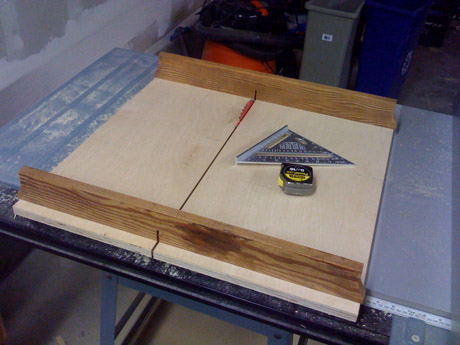
One of the most simple and useful things I have made in my shop so far is this crosscutting jig. It is perfect for when your chop saw just doesn’t reach far enough to cut a big piece of wood. Also, I have much nicer blades for my table saw then I do for my chop saw. Either way, it is a quintessential jig to have in your shop.
I made this one with some scrap wood I had lying around the shop in a matter of an hour or so. The base is made from birch veneered plywood and the rails are made from oak. I bought the T-tracks to guide the sled from Rockler, my new favorite store. Other than that, there’s not much to it. I decided to use dowels to hold it all together but screws or any other type of joinery would work just as well.
The most important part is getting it square obviously. What I did was made the base perfectly square, measured the distance between the tracks on my saw, then attached the tracks to the sled. Then I clamped the jig the saw, turned on the blade and raised it up through the wood. Now with my T-square I am able to line up the pieces that hold the wood perpendicular to the blade. Thats all there is to it. This design is very simple and straightforward but if you browse around the web you will find all sort of different designs, additions, and safety additions.
(More pictures can be found in this Flickr set)

For years I have been trying to create a Media Center to attach my TV. I’ve tried Windows Media Center years ago, Myth TV on Linux, and everything in between. Nothing was simple, cheap, and easy to setup. I have friends who have tried those off the shelf media boxes like the ones from Netgear and the likes, but those have their pitfalls too. I wanted something open source, truly hackable, and preferably something Unix/Linux based. Thats why I turned to the Apple TV.
For my use case, I did not care about disk storage. I am using my Apple TV’s as terminals or endpoints to play media from storage somewhere else on the network. This allowed me to buy the cheap version of the Apple TV with a 40 GB drive for about $220. Not only that, there is a Toslink (optical) out that I will be attaching to a DAC and set of vintage tubes for crisp beautiful sound. For that kinda money, its pretty hard to beat the Apple TV.
Once in my possession, I immediately hacked it to expand its functionality. Without it, the Apple TV is actually pretty restricted and an overall weak product; however, Boxee helps make it all better. Boxee allows you to watch all those formats that iTunes does not support, like DivX, etc. Not only that, it allows you watch Hulu as well as other online video services.
Hacking your Apple TV and Installing Boxee
There’s actually nothing to do really and I would barely consider it hacking. A few folks out there have made it quite easy. In a nutshell, all you need to do is create a ‘patchstick’ on your PC using a thumb drive you have laying around. You insert it into your Apple TV’s USB drive, restart it, and voila! It installs itself and you’re all set. You can get the USB Patch Stick creator from the Google code repository.
If you’re house is even half as old as mine is, its likely that you have similar sash and weight style windows. You know, the ones that are cold, drafty and often times have snapped ropes? Luckily, they are pretty simple to work on for the average do-it-yourselfer. Eventually I am going to replace the weights with spring balances and insulate but for now they just needed to be done. Another person helps but this definitely could be done on your own. These windows usually arent too heavy. There is plenty of information and how-to’s out there on YouTube and and This Old House’s web site.
In my case, I needed to duplicate some weight pocket doors because I was missing a set. This unfortunately is a little more advanced but anyone with some table saw skills can make these. All you need is a miter and some scrap wood. More pictures and descriptions can be found on my flikr page.